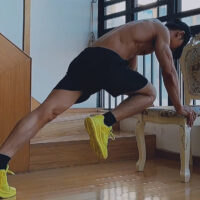
Exercise Guide
Advanced Protocols for Core Stabilization and Lower Body Re-Composition
The synergy between isometric holds and dynamic unilateral movements creates a unique stimulus for the Transverse Abdominis (TVA) and the Gluteal Complex. By using a wall, we eliminate the compensatory movements often seen in free-standing exercises, forcing the primary movers to bear the full mechanical load. This results in a more tapered waistline and denser, more defined quadriceps and hamstrings.
1. The Clinical Wall Sit: Isometric Tension Protocol
The Wall Sit is far more than a test of willpower; it is a sophisticated isometric contraction that recruits high-threshold motor units. By fixing the spine against a flat surface, we isolate the lower body while requiring the deep core to maintain a rigid intra-abdominal pressure.

Execution Mechanics:
- Alignment: Position your spine flush against the wall. Descend until the knee and hip joints achieve a 90-degree flexion. Your thighs must be parallel to the horizontal plane.
- Pelvic Tilt: Perform a conscious posterior pelvic tilt. Press the small of your back into the wall to eliminate any lumbar gap. This engages the lower abdominals and stabilizes the spine.
- Ground Force: Distribute weight evenly across the calcaneus (heel) and the mid-foot. Do not allow the knees to transcend the vertical line of the toes.
- The Hold: Maintain the position while performing diaphragmatic breathing, keeping the tension constant in the quads.
Level Up: Place a weighted plate or a heavy object on the distal third of the thighs to increase the mechanical load on the quadriceps femoris.
| Muscle Group | Role in Wall-Based Training | Visual Impact |
|---|---|---|
| Transverse Abdominis | Acts as a biological corset during wall-supported moves. | Reduces “lower belly pooch” and cinches the waist. |
| Vastus Lateralis | Primary mover in deep knee flexion exercises. | Creates the “outer sweep” and definition of the thighs. |
| Multifidus | Stabilizes the vertebrae against the wall surface. | Improves postural uprightness and spinal health. |
2. Wall-Tactile Lunges: Dynamic Stability Work
Traditional lunges are often plagued by lateral instability, causing the quads to take over and the core to disengage. Using a wall for tactile feedback allows for a deeper range of motion (ROM) and better engagement of the hip stabilizers.

Execution Mechanics:
- The Setup: Stand perpendicular to the wall. Use the wall for light finger-tip balance only—not as a leaning post.
- The Descent: Execute a long stride. Lower the rear knee until it is mere millimeters from the floor. The front tibia should remain vertical.
- Core Integration: Exhale during the concentric (rising) phase, pulling the navel toward the spine to prevent pelvic wobbling.
Prescription: 3 Sets of 20 Repetitions per limb. Focus on a 2-second eccentric phase.
3. Wall-Supported Unilateral Deadlifts
This is a masterclass in posterior chain recruitment. The wall eliminates the “balance barrier,” allowing the trainee to focus entirely on the hinge mechanic and the contraction of the hamstrings and glutes.

Execution Mechanics:
- The Hinge: Stand with one side toward the wall. Soften the knee of the standing leg.
- The Reach: Simultaneously hinge at the hips while extending the opposite leg back. The torso and the rear leg should form a perfect horizontal line.
- Tactile Guidance: Use the wall to ensure your hips stay “square” (facing the floor). Rotating the hips outward is a common compensatory error that shifts load away from the hamstrings.
Expert Integration Strategy
To achieve physiological change, one must adhere to the principle of progressive overload. While these exercises can be performed in under 10 minutes, the intensity must be maximal. Perform this circuit 4–5 times per week.
Optimization Protocol:
- ✓ Micro-Breaks: Rest only 30 seconds between exercises to maintain a high metabolic rate.
- ✓ Hydration & Electrolytes: Isometric work causes high intramuscular pressure; ensure adequate sodium and potassium intake to prevent cramping.
- ✓ Consistency: The “flattening” of the belly is a result of consistent TVA activation. Treat every rep as a core exercise.
The wall is not just a boundary—it is your most effective training partner. Start today.