Exercise Guide
In clinical aesthetics and functional kinesiology, the term “bra bulge” refers to the soft tissue protrusion often localized around the axillary region and subscapular area. From a physiological standpoint, this is rarely caused by excess adipose tissue alone. More often, it is a symptomatic manifestation of postural kyphosis (slouching), scapular winging, and the atrophy of the Rhomboids and Lower Trapezius muscles. When the muscular support of the upper back weakens, the skin and underlying fascia lack the structural tension required to remain smooth, leading to the appearance of “folds.”
This professional routine is designed not just to “burn fat,” but to achieve muscular hypertrophy in the posterior chain. By increasing the density of the muscles surrounding the shoulder blades, you create a natural “shelf” that pulls the tissue taut, instantly improving the silhouette in sleeveless attire. No specialized facility is required; these movements leverage light resistance and precise biomechanics to yield maximum definition.
1. The Precision Upright Row
The Upright Row is a vertical pulling movement that addresses the “tie-in” between the shoulder and the upper back. By elevating the humerus in the frontal plane, we target the fibers responsible for the “lift” at the top of the bra line.
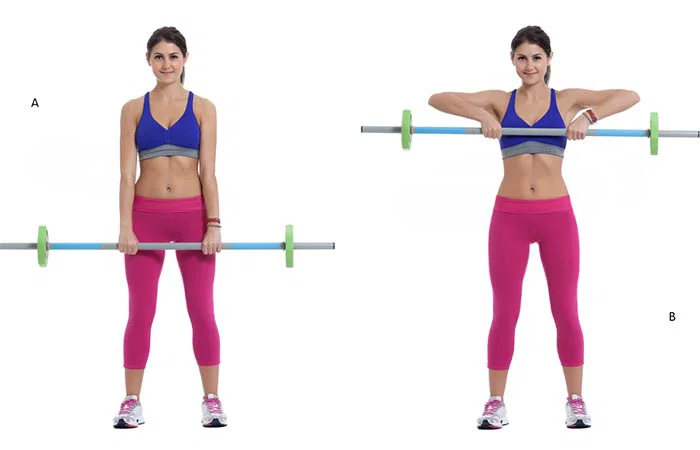
Execution Mechanics:
- Initial Stance: Stand with feet in a neutral hip-width position. Hold your weights (dumbbells or water bottles) anterior to the thighs with a pronated grip (palms facing inward).
- The Vertical Drive: Inhale to brace the core, then exhale as you pull the weights toward the clavicle. The elbows must always lead the movement, remaining higher than the wrists at all times.
- Depth: Cease the ascent at mid-chest level. Elevating higher than this can lead to subacromial impingement—a common error in shoulder training.
- Eccentric Control: Lower the weights slowly over a 3-second count to maximize time under tension.
Prescription: 3 Sets | 12–15 Repetitions | 45s Rest
2. Hinge-Focus Triceps Kickbacks
What many perceive as “underarm bulge” is often laxity in the triceps. This isolation exercise targets the long head of the triceps, which sits directly adjacent to the posterior axilla (the back of the armpit).
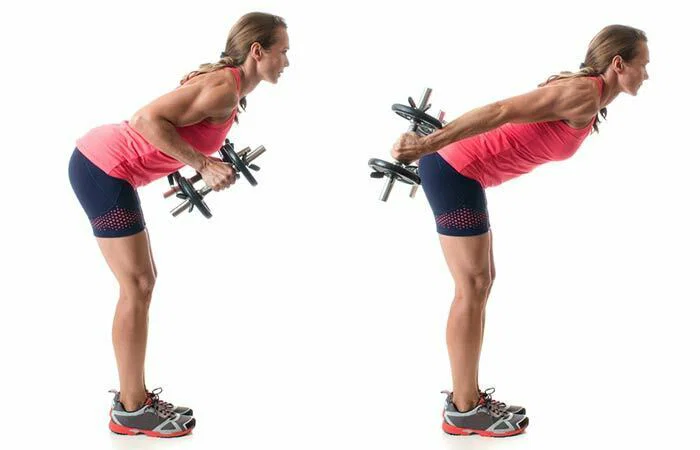
Execution Mechanics:
- The Hinge: Bend at the hips to a 45-degree angle. Maintain a perfectly neutral spine (no lumbar rounding).
- Locking the Lever: Pull your elbows up until the upper arm is parallel to the floor. The elbow is now the “hinge” and must remain frozen in space.
- Extension: Exhale and fully extend the arms behind you. At the peak of the movement, rotate your palms toward the ceiling for an extra contraction.
- Return: Stop at the 90-degree point; do not allow momentum to swing the weights forward.
Prescription: 4 Sets | 15 Repetitions | 30s Rest
| Target Muscle | Functional Role in “Bra Bulge” Reduction | Visual Outcome |
|---|---|---|
| Rhomboids | Pulls the shoulder blades toward the spine. | Smooths the mid-back area and eliminates folds. |
| Medial Deltoid | Creates the “cap” of the shoulder. | Provides a lifted, athletic upper frame. |
| Lats (Latissimus Dorsi) | Broadest muscle of the back. | Cinches the sides of the torso for a V-taper. |
3. Controlled Front Lateral Raises
While the back is the focus, the anterior (front) shoulder and upper chest provide the necessary “frontal tension” to prevent tissue from sagging forward into the armpit.
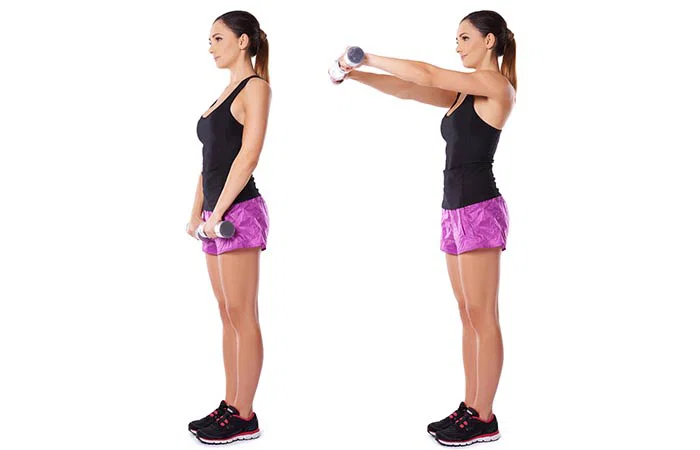
Execution Mechanics:
- Posture: Stand “tall” with an active core. Hold weights at the front of your thighs.
- The Lift: With a slight micro-bend in the elbows, raise the weights directly in front of you until they are level with your eyes.
- Avoid Compensation: Do not rock the body or use the legs for momentum. If you must swing, the weight is too heavy.
4. Frontal Plane Lateral Raises
If there is one exercise to define the “cap” of the shoulder, this is it. It targets the medial deltoid, the specific muscle that defines the silhouette in tank tops.

Execution Mechanics:
- The Grip: Hold dumbbells at your sides. Lead with the knuckles toward the ceiling.
- The Path: Raise arms out to the side. Imagine you are pouring two pitchers of water at the top of the movement (a slight internal rotation).
- The Stop: Do not go above shoulder height. Going higher shifts the work to the Trapezius and away from the targeted deltoid.
Prescription: 3 Sets | 12 Repetitions (Slow Tempo)
5. Unilateral Dumbbell Rows
This is the “Power Move” of the routine. It is a multi-joint compound movement that targets every major muscle group in the upper back.

Execution Mechanics:
- Support: Place one hand on a stable surface (bench or table) and hinge until your torso is nearly parallel to the floor.
- Full Range of Motion: Start with the arm fully extended, feeling a stretch in the shoulder blade.
- The Row: Pull the weight toward your hip, not your shoulder. This ensures you are using your back muscles rather than just your biceps.
- The Squeeze: Retract the shoulder blade as hard as possible at the top.
Expert Summary & Lifestyle Integration
Transformation is a marriage of Mechanical Stimulus and Systemic Recovery. To see a definitive reduction in upper back folds, these exercises should be performed consistently for 4–6 weeks.
Final Specialist Tips:
- ✓ Hydration: Maintain fascia elasticity by drinking 3L of water daily.
- ✓ Postural Mindfulness: Every 30 minutes, perform a “scapular squeeze” (pinch your shoulder blades) to keep the muscles active.
- ✓ Nutrition: Support muscle hypertrophy with lean proteins (1.2g per kg of body weight).
Stand tall, train with precision, and the strength you build will define the style you wear.